Cogeneration offers numerous advantages to energy-intensive companies, as it allows them to increase energy efficiency, thus reducing costs and CO2 emissions into the atmosphere.
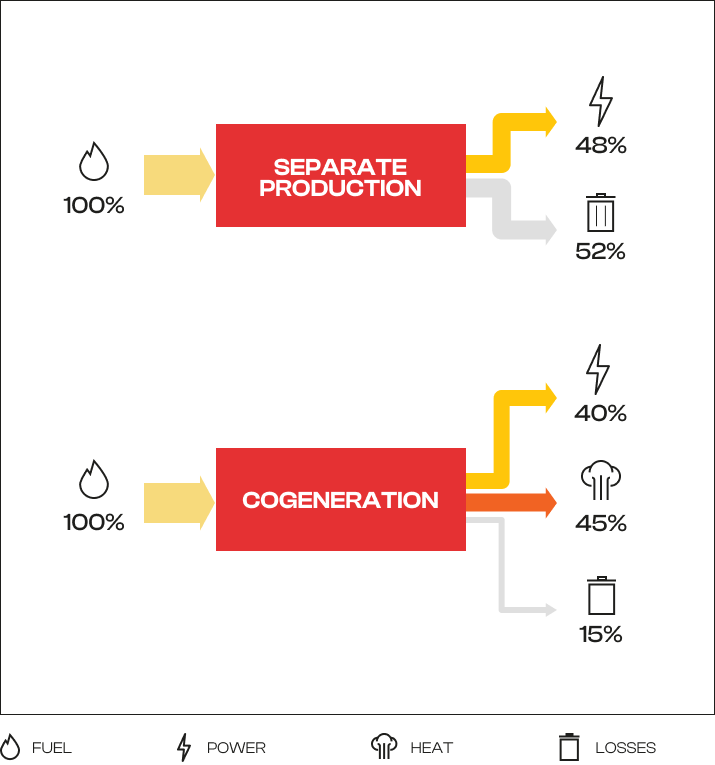
There cogeneration or CHP (Combined, Heat and Power) means producing simultaneously electricity and heat from a single energy source.
The cogeneration plants, unlike traditional thermoelectric power plants, simultaneously produce electrical and thermal energy using a single primary energy source. The heat generated during combustion is used to produce electricity while the residual thermal energy that would normally be lost is recovered to produce hot water or for the production processes of the plants.
02 Trigeneration
There trigeneration or CCHP (Combined Cooling Heating and Power) is a process that, in addition to electrical and thermal energy, can also produce cooling energy in the form of chilled water.
There refrigeration is carried out by a specific machine called an absorption refrigerator which, through a series of evaporation and condensation cycles, cools the working fluid. These processes, unlike normal compression cycles, are not powered by electricity but are generated by hot water or steam recovered from the waste heat of cogeneration.
03 High efficiency cogeneration
Considering that energy savings can vary from plant to plant, the European Directive 2004/8/CE establishes that cogeneration can be defined as high-efficiency cogeneration (CAR) if the primary energy saving (PES) value is higher than certain thresholds.
PES, acronym for Primary Energy Saving, expresses the primary energy savings achievable by a cogeneration plant compared to separate plants for the generation of thermal and electrical energy.
Therefore, the PES defines the efficiency of the cogeneration plant compared to the separate production carried out by dedicated plants (on the basis of national average parameters).
High-efficiency cogeneration (CAR) is defined as the production of heat and electricity by cogeneration units that guarantees primary energy savings (PES) equal to:
PES > 0% – for micro and small cogeneration units, i.e. with a generation capacity of up to 1 MWe;
PES >= 10% – for cogeneration units with generation capacity greater than 1MWe
04 White Certificates
THE TEE (Energy Efficiency Certificates), also known as White Certificates, are released for high-efficiency cogeneration plants.
It is a tool aimed at promoting energy efficiency in Italy.
These are negotiable securities that certify the savings obtained. The savings are measured in Tonnes of Oil Equivalent (TOE) and one TOE corresponds to one White Certificate.
02
benefits
Cogeneration represents the best solution for companies that want to combine energy efficiency and cost reduction with respect for the environment.
Let's discover the main advantages together:
recognition of high efficiency cogeneration
reduction of fuel consumption
sustainability
savings
tax benefits
energy independence
reduction of co2 emissions
Cogeneration represents the best solution for companies that want to combine energy efficiency and cost reduction with respect for the environment.
Let's discover the main advantages together:
recognition of high efficiency cogeneration
reduction of fuel consumption
sustainability
Savings
Tax benefits
energy independence
reduction of co2 emissions
03
implementation phases
FEASIBILITY STUDY
After an initial approach with the customer in which the first ideas on the optimal configuration of the plant are outlined, an initial sizing of the plant and the related business plan are prepared in order to determine the technical/economic feasibility of the investment.
AUTHORIZATION
The cogeneration plants must be authorized for various aspects: from environmental and noise emissions to connection to the electricity grid through construction authorizations. These are processes that MERCURIO manages internally for its customers.
BASIC DESIGN
The early design stages establish the positioning of the machines and pipes as well as allowing the sizing of all the equipment making up the system.
DETAILED DESIGN
The design continues with the fine definition of the system details so that the construction phases develop in a timely and efficient manner.
CONSTRUCTION
The construction phase, whether it is the prefabrication of pipes or the construction of machinery or carpentry, is entrusted to consolidated partners and constantly monitored through dedicated expediting.
The timely delivery of supplies, respecting the required quality, is a fundamental goal to guarantee the success of the project.
INSTALLATION
This phase represents the most important phase of the plant construction and, if not managed properly, could compromise project plans, significantly extending delivery times.
To ensure the success of the installations on site, MERCURIO uses not only a Site Manager who effectively coordinates the works, but also Project Engineers who continuously monitor the quality and correspondence of the installations with respect to the project.
PUT INTO PRODUCTION
Once the installation is completed, the commissioning phase begins. Commissioning can be divided into cold commissioning and hot commissioning (or start-up). Cold Commissioning includes all the mechanical and electrical verification activities that allow the system to be started up safely and efficiently. Hot start-up starts from the circulation of fluids within the hydraulic circuits up to the performance tests of the systems supplied.
MAINTENANCE
At the end of the performance tests, the plant begins the commercial operation phase. From this point on, it is essential, in order to minimize plant downtime, to manage and maintain the plant in a preventive and planned manner, managing spare parts in stock and performing predictive failure analyses.
FEASIBILITY STUDY
After an initial approach with the customer in which the first ideas on the optimal configuration of the plant are outlined, an initial sizing of the plant and the related business plan are prepared in order to determine the technical/economic feasibility of the investment.
AUTHORIZATION
The cogeneration plants must be authorized for various aspects: from environmental and noise emissions to connection to the electricity grid through construction authorizations. These are processes that MERCURIO manages internally for its customers.
BASIC DESIGN
The early design stages establish the positioning of the machines and pipes as well as allowing the sizing of all the equipment making up the system.
DETAILED DESIGN
The design continues with the fine definition of the system details so that the construction phases develop in a timely and efficient manner.
CONSTRUCTION
The construction phase, whether it is the prefabrication of pipes or the construction of machinery or carpentry, is entrusted to consolidated partners and constantly monitored through dedicated expediting.
The timely delivery of supplies, respecting the required quality, is a fundamental goal to guarantee the success of the project.
INSTALLATION
This phase represents the most important phase of the plant construction and, if not managed properly, could compromise project plans, significantly extending delivery times.
To ensure the success of the installations on site, MERCURIO uses not only a Site Manager who effectively coordinates the works, but also Project Engineers who continuously monitor the quality and correspondence of the installations with respect to the project.
PUT INTO PRODUCTION
Once the installation is completed, the commissioning phase begins. Commissioning can be divided into cold commissioning and hot commissioning (or start-up). Cold Commissioning includes all the mechanical and electrical verification activities that allow the system to be started up safely and efficiently. Hot start-up starts from the circulation of fluids within the hydraulic circuits up to the performance tests of the systems supplied.
MAINTENANCE
At the end of the performance tests, the plant begins the commercial operation phase. From this point on, it is essential, in order to minimize plant downtime, to manage and maintain the plant in a preventive and planned manner, managing spare parts in stock and performing predictive failure analyses.
Our company has developed highly specialized skills that allow it to perform internally every single phase necessary for the development and design of the systems.





















 English
  Italian